


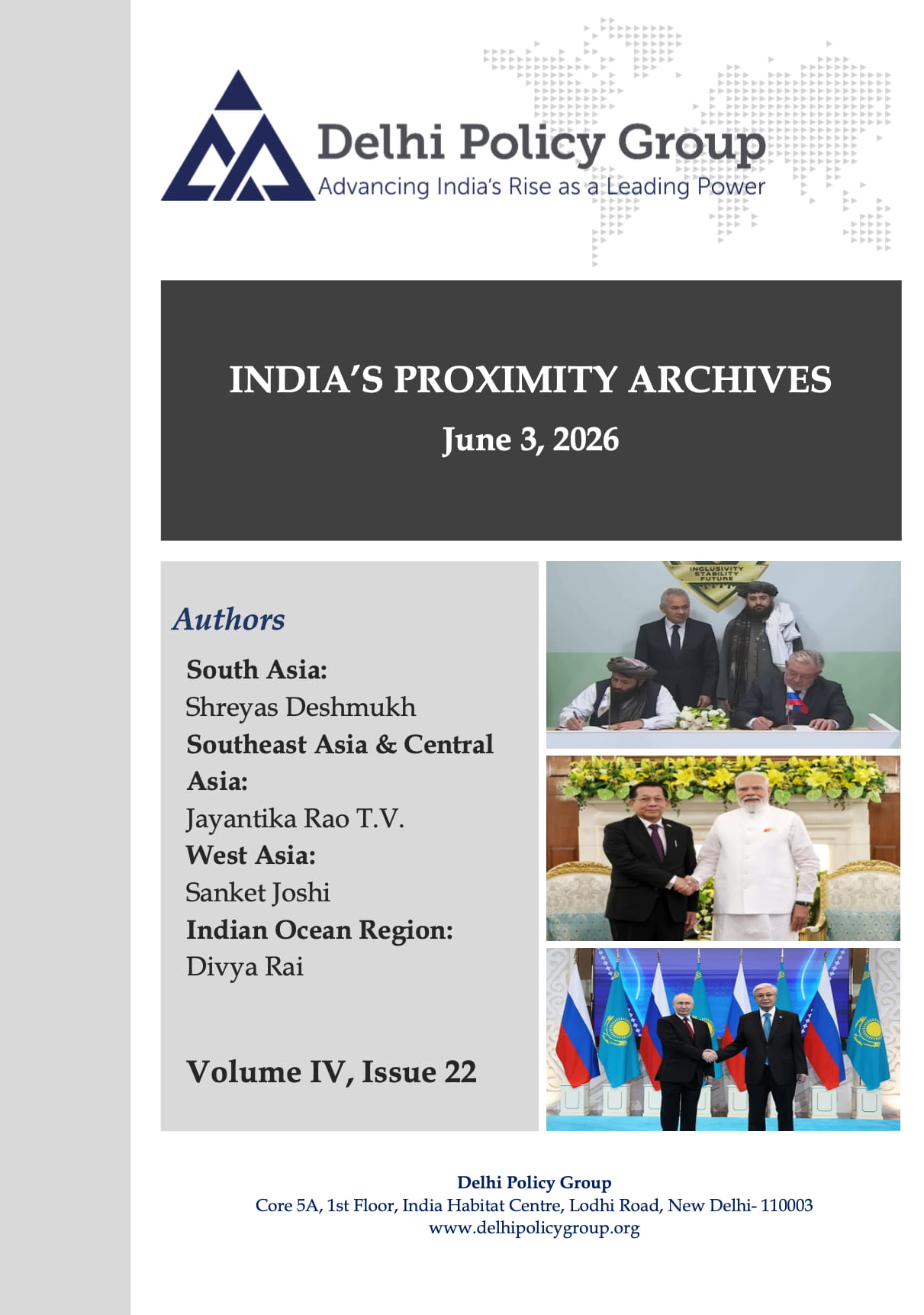
India’s Proximity Archives
South Asia
A statement by Prime Minister Balen Shah regarding the border issue with India on May 31 led to protests within Nepal’s Parliament. During a parliamentary response, PM Shah indicated that encroachment was not solely by India, Nepal has also encroached on Indian land in numerous areas. He further stated that the UK should participate in discussions to settle the border dispute. Foreign Ministry spokesperson Lok Bahadur Paudel Kshetri later explained that the Prime Minister’s statements addressed topics such as “boundary pillars, no-man’s land, and cross-border land usage.” India’s Ministry of External Affairs stated that approximately 98% of the India-Nepal border has been demarcated. It also clarified that ongoing discussions through bilateral mechanisms are addressing the remaining unresolved segments, and ruled out involvement of third parties in this process. Meanwhile, Rabi Lamichhane, the chairman of Nepal’s ruling Rastriya Swatantra Party (RSP), is visiting India from June 1-5 at the invitation of the BJP
Southeast Asia
President of Myanmar, U Min Aung Hlaing arrived in India for a five-day state visit, his first to the country since leading the military coup of 2021, and since becoming the elected president, on May 30. On June 1, he met India’s Prime Minister Narendra Modi. Both leaders pledged to strengthen cooperation in domains such as trade, defence and security, border management, technology, energy and critical minerals, and pledged to accelerate major connectivity projects. India’s decision to receive Min Aung Hlaing with full state honors prompted controversy, with domestic and regional civil society groups condemning the decision. However, Indian Foreign Secretary Vikram Misri defended New Delhi’s decision to re-engage with the new “civilian” government in Naypyidaw and said that India’s policy is “not intended to be a commentary on the internal political arrangements.”
West Asia
The U.S. military targeted and "disabled" an oil tanker heading towards Iran on June 2, reportedly violating the American naval blockade, marking another escalation in the U.S.-Iran conflict since the Pakistan-mediated ceasefire. The U.S. also struck Iran’s Qeshm Island in the Strait of Hormuz, targeting air defence systems and a drone control station that posed a threat to shipping in the region. Reacting to this, Iran’s Islamic Revolutionary Guard Corps (IRGC) launched missile and drone attacks on the U.S. Fifth Fleet Headquarters in Bahrain. Iran’s new Supreme Leader, Ayatollah Mojtaba Khamenei, urged national unity amidst hostile attempts to create divisions and hailed the Iranian people’s character in their “third sacred defence” against foes like Israel and the U.S.
Central Asia
On May 28, Russian President Vladimir Putin held talks with President of Kazakhstan Kassym-Jomart Tokayev at the Palace of Independence in Astana. The talks began with a restricted-format conversation and continued in an expanded format. The two leaders signed the Joint Statement on the Seven Foundations of Friendship and Neighbourliness between the People of Russia and Kazakhstan. The bilateral documents signed during Vladimir Putin’s state visit to Kazakhstan include intergovernmental agreements on the basic principles and terms of cooperation for the construction of a nuclear power plant in Kazakhstan, as well as on the provision of a state export loan to the Government of Kazakhstan to finance the project; and on expanding cooperation in the oil sector.
Indian Ocean Region
Raksha Mantri Shri Rajnath Singh and Australian Deputy Prime Minister and Minister for Defence Mr Richard Marles co chaired the second India–Australia Defence Ministers’ Dialogue at the Manekshaw Centre in New Delhi on June 1, 2026. Both leaders welcomed progress toward implementing their Prime Ministers’ commitment to renew and strengthen the Joint Declaration on Defence and Security Cooperation. They reviewed advances in bilateral maritime security cooperation and ongoing work to finalise the Joint Maritime Security Collaboration Roadmap. Both sides also encouraged expanded cooperation between the Indian Coast Guard and Australia’s Maritime Border Command. The two countries committed to exploring arrangements to improve procedural interoperability for exercises and operations, building on the 2020 Mutual Logistics Support Arrangement, and to continue reciprocal aircraft deployments to develop operational familiarity. The Ministers further announced that India and Australia will commence drafting a Memorandum of Understanding on the Provision of Defence Articles and Defence Services.