


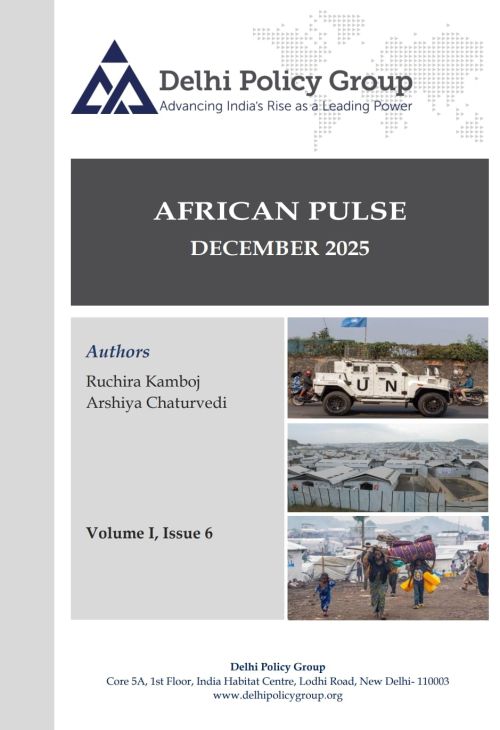
African Pulse
This monthly presents studies on strategic and economic security developments in Africa, which hold particular relevance for India.
In this latest issue, the authors examine the conflict in eastern DRC, a complex interplay of ethnic tensions, competition over critical minerals, and the involvement of local, regional, and international actors.
The conflict has its roots in the aftermath of the 1994 Rwandan genocide, which triggered population movements into eastern DRC and intersected with long-standing local grievances. Over time, the involvement of neighbouring states and the emergence of multiple armed groups entrenched instability, particularly in the Kivu provinces.
The discovery and exploitation of critical minerals added a powerful economic dimension. The Democratic Republic of the Congo holds exceptional reserves of cobalt, copper, gold, and other strategic resources. In eastern DRC, the concentration of valuable and easily exploitable minerals has drawn a growing number of actors, deepening the conflict and giving it an increasingly global character.
Multiple players have sought to mediate and stabilise the situation. The United States, the African Union, and the United Nations have all been involved. The Washington Accords for Peace and Prosperity, signed on December 4, 2025 between the DRC and Rwanda and hosted by the United States, have struggled to gain traction. African-led efforts, including the Angola-facilitated Luanda process, have also yielded limited results. The UN mission, MONUSCO, remains present despite earlier plans for drawdown.
The conflict today reflects a convergence of historical grievances, ethnic mistrust, regional geopolitics, and economic competition. Long-standing distrust between the DRC and Rwanda continues to complicate de-escalation, while armed groups remain active on the ground.
Against this backdrop, progress appears plausible only through a combination of inclusive political engagement, sustained regional and international facilitation, and gradual strengthening of national capacities. Over time, such an approach could help the DRC move beyond recurring cycles of violence and better harness its development potential for the wider region.
To read this African Pulse, Vol. I, Issue 6, please see the PDF attached.