


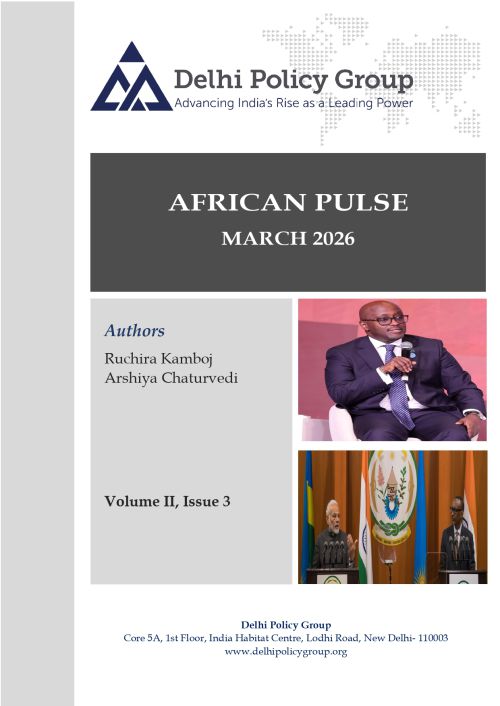
African Pulse
This monthly presents studies on strategic and economic security developments in Africa, which hold particular relevance for India. In this issue, the authors focus on Rwanda’s rise as an emerging African power and partner.
Rwanda presents a compelling story of transformation, a country modest in size yet strategic in reach. From the devastation of the 1994 genocide, it has charted a steady trajectory toward recovery and renewal, driven by an ambitious, state-led development model under Vision 2050, with the goal of becoming an upper-middle-income economy.
Over the past two decades, Rwanda has built a reputation for efficiency, policy clarity, and disciplined implementation. Its governance model has at times invited comparisons with Singapore, particularly for its emphasis on order, policy discipline, and long-term planning.
Beyond its economic identifiers, Rwanda has also emerged as a credible regional security provider. Its contributions to UN peacekeeping missions, alongside bilateral force deployments in Mozambique’s Cabo Delgado, have enhanced its profile as an agile security actor.
India established diplomatic relations with Rwanda in 1999, and ties have since evolved steadily in scope and substance. Today, the partnership is increasingly aligned with Rwanda’s Vision 2050 priorities, with growing cooperation in areas such as digital skills, artificial intelligence, biotechnology, and digital public infrastructure. Capacity building, training, and defence cooperation have also emerged as important pillars, alongside expanding trade and investment linkages. The visit of Prime Minister Narendra Modi to Rwanda in 2018 marked a decisive inflection point in the relationship.
Recent high-level engagements have reinforced this trajectory. The visit of Rwanda’s Foreign Minister, Olivier J.P. Nduhungirehe, to India for the Raisina Dialogue (March 5–7, 2026) provided an opportunity to further consolidate ties. His remarks underscored India’s role as a development partner, while identifying areas for deeper cooperation, including digital literacy, ICT, manufacturing, and technological innovation, sectors where India’s experience is both relevant and adaptable.
Even as Rwanda maintains a diversified set of partnerships, including with the European Union and the United States, India offers a complementary model of engagement. Drawing on its strengths in digital public infrastructure, capacity-building, and small enterprise development, India’s demand-driven approach aligns closely with Rwanda’s priorities in skills development, value addition, and technological transformation.
Looking ahead, there remains significant scope for this partnership to deepen further. Underpinned by mutual priorities and practical cooperation, India-Rwanda ties can contribute to sustainable and inclusive growth, while reinforcing the broader ethos of South-South collaboration. The forthcoming India-Africa Forum Summit is expected to provide additional momentum in this direction.
To read this issue please click African Pulse, Vol. II, Issue 3.