


China Monitor
The monitor features developments related to China during the month and is compiled by our research team of Amb. Biren Nanda, Senior Fellow, and Sanket Joshi, Research Associate, from open-source reports and publications.
On April 10, 2026, China released a new list of 23 “standardised” names for places in India’s state of Arunachal Pradesh, which Beijing refers to as Zangnan (South Tibet). On April 12, 2026, India categorically rejected China’s mischievous attempts to assign fictitious names to places in Arunachal Pradesh, adding that “false claims” and “baseless narratives” cannot alter the reality that Arunachal Pradesh is an integral and inalienable part of India. New Delhi cautioned that such actions by the Chinese side undermine efforts to stabilise and normalise bilateral relations.
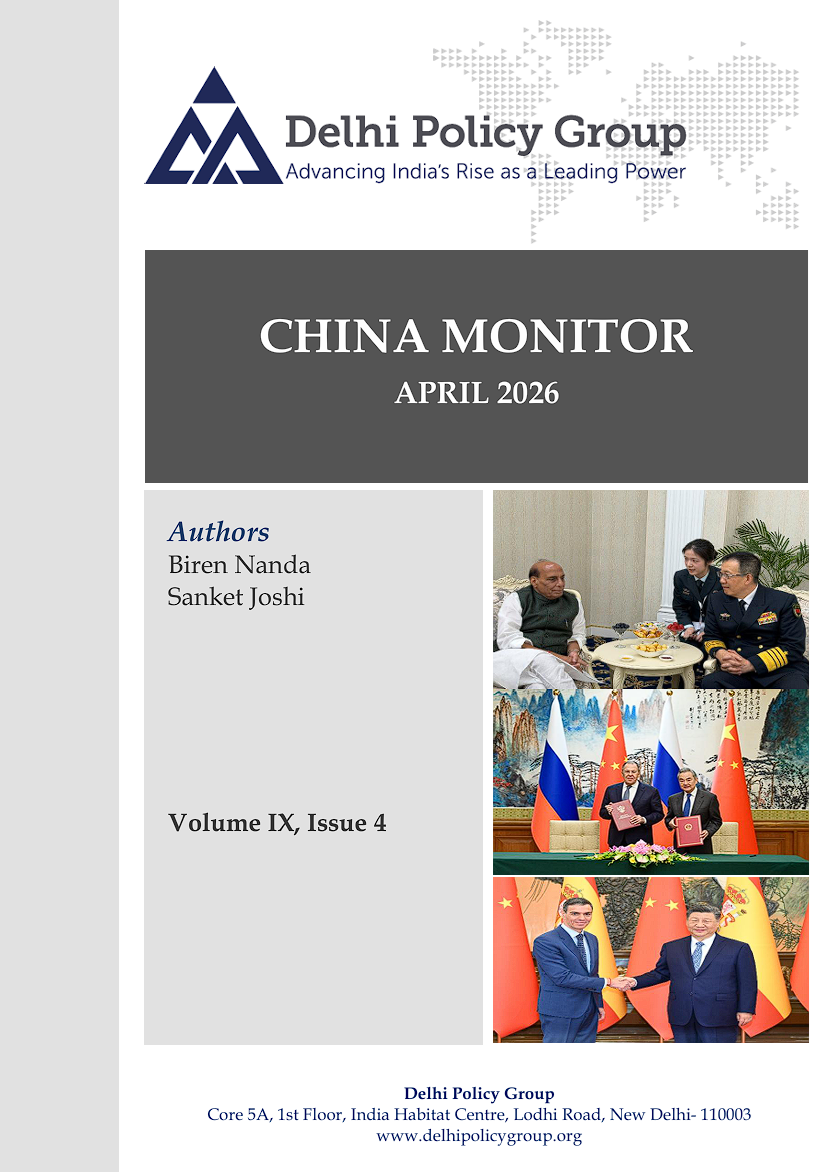
High-level engagements between India and China continued. On April 28, 2026, India’s Defence Minister Rajnath Singh and China’s Defence Minister Admiral Dong Jun met on the margins of the SCO Defence Ministers’ meeting in Bishkek, Kyrgyzstan. They discussed the importance of maintaining peace and tranquillity along the LAC as well as broader regional security issues, including the ongoing conflict in West Asia.
On April 2, 2026, one year after President Trump announced Liberation Day tariffs, the White House announced that the U.S.' goods trade deficit with China had decreased by 32 percent over the past year, and by 46 percent from April 2025 to January 2026.
Ahead of President Trump’s visit to China, on April 30, 2026, Chinese Foreign Minister Wang Yi and U.S. Secretary of State Marco Rubio held a phone conversation. Wang Yi reportedly cautioned the U.S. that the Taiwan question is fundamental to China's core interests, and that it poses the “biggest risk to China-U.S. relations”. He urged Beijing and Washington to safeguard the hard-won stability in bilateral relations.
Cheng Li-wun, the Chairperson of Taiwan’s Kuomintang (KMT) party, visited mainland China from April 7-12, 2026. She was received by President Xi on April 10, 2026, with the two leaders calling for joint efforts between the CPC and KMT to promote cross-strait peace and oppose “Taiwan independence”.
Continuing the deepening trend of the China-Russia strategic partnership, on April 14, 2026, Chinese Foreign Minister Wang Yi and Russian Foreign Minister Sergei Lavrov held talks in Beijing. Wang Yi noted that China-Russia relations remain “unshaken” by global turmoil, with cooperation becoming stronger across various fields.
China’s GDP grew by 5 percent year-on-year in the first quarter of 2026. Beijing emphasised that this demonstrates China’s economic resilience and reinforces the country’s role as a “stabilising force in a volatile global economy”.
To read this issue please click China Monitor, Vol. IX, Issue 4.