


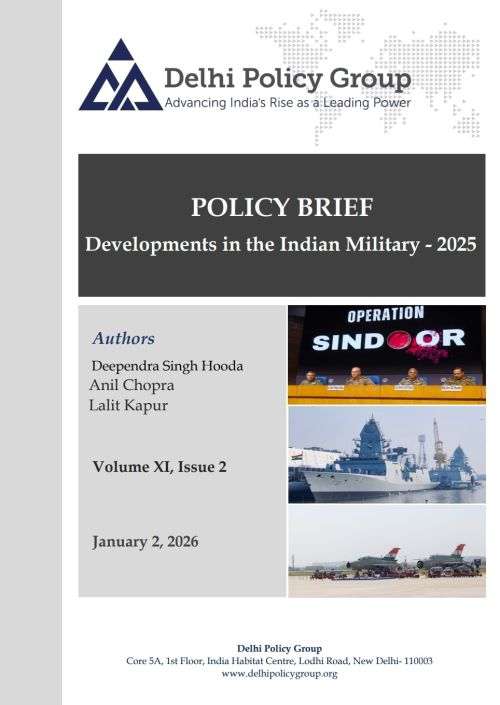
Developments in the Indian Military - 2025
2025 witnessed significant military developments worldwide, characterised by high-end wars in Europe and the Middle East, as well as several other conflicts raging from Asia to Africa and even South America. The military scenario was dominated by technological advancements, the integration of autonomous and AI-enabled systems, evolving alliances, force reforms, and increasing defence budgets.
The most significant event for the Indian military was “Operation Sindoor,” launched against Pakistan on May 7 in response to the massacre of 26 tourists in Pahalgam, Jammu and Kashmir by Pakistan-based terrorists. After India struck terrorist camps in Pakistan, the situation escalated with drone and missile attacks across the length of the India-Pakistan border. On May 10, the Indian Air Force (IAF) launched a devastating strike against 11 Pakistani airbases. The extensive damage caused led Pakistan to request a ceasefire, which India accepted.
The Indian political and military leadership has repeatedly asserted that Operation Sindoor has only been paused, not terminated. Indiamade it clear that any terror attack from Pakistan would trigger a decisive retaliation and that there would be no differentiation between terror groups and those who shelter them. The ceasefire, though in effect, stands on shaky ground.
At the Line of Actual Control (LAC) with China, complete disengagement at all friction points had been completed by late 2024. The focus in 2025 was on ensuring the LAC remained calm through regular interactions between local military commanders. A series of high-level political engagements, including a meeting between Prime Minister Narendra Modi and President Xi Jinping in Tianjin on August 31, led to a gradual thaw in ties. However, de-escalation has yet to happen, and both militaries remain in a state of enhanced readiness along the LAC and continue to upgrade the border infrastructure.
The porous India-Myanmar border remains an increasing concern for India. The Centre’s decision to fence the border and revoke the Free Move Regime has met resistance from the Nagaland and Mizoram State governments, and only about 10 km of the 1,643 km border has been fenced.
Although the government appears committed to raising the Integrated Theatre Commands (ITCs), there is still no consensus among the three services on the structure of the ITCs. Quoting the success of Operation Sindoor achieved under the existing system, the IAF Chief, Air Chief Marshal A P Singh, has cautioned against rushing into the creation of ITCs. This dissonance will have to be overcome if the ITCs are to take shape in 2026.
Drawing lessons from Operation Sindoor, the Indian Army’s procurements in 2026 were focused on acquiring unmanned systems. It is also raising new organisations, such as the Rudra all-arms Brigades, Bhairav light commando battalions, and Ashni drone platoons in all infantry battalions.
The Indian Navy commissioned 10 ships and a second MH60R helicopter squadron. An agreement was signed with France to procure 26 Rafale-Marine fighter jets for the two aircraft carriers. However, delays persist in the Navy’s Project 75I to build six stealth submarines.
The dwindling strength of the Indian Air Force (IAF) is a matter of concern. The IAF is down to 29 fighter squadrons against a sanctioned strength of 42. The delivery of Tejas Mk1A fighter jets has been delayed, and the first aircraft will enter service in 2026. To address its shortfalls, the IAF has proposed procuring 114 Rafale fighters.
2025 saw continued focus on defence indigenisation, with more than 90% of the total contracts awarded to the domestic industry. Foreign companies like Boeing, Airbus, Safran, and Dassault Aviation are partnering with Indian companies to manufacture advanced military equipment.
The experiences of 2025 have underscored the reality of a “two-front threat” for India. This understanding will carry over into 2026, requiring a high level of operational readiness on both fronts. To sustain capability building and modernisation, the defence budget needs much greater outlays.
To read this DPG Policy Brief Vol. XI Issue 2, please click “Developments in the Indian Military - 2025”.