


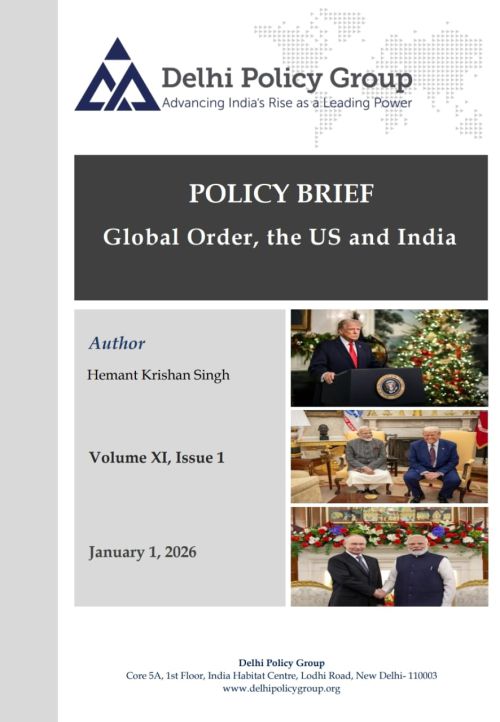
Global Order, the US and India
In this opening brief of the new year, the author assesses the nature of the prevailing global order, the strategic posture and national security priorities of the United States, and the implications for India, given the continuing impasse in India-US relations over the imposition of punitive tariffs and more.
2025 was a roller-coaster year of global tumult and disruption, the centrepiece of which was radical change in how America deals with the world, accelerating already ongoing transformations in the international space. The comity of nations is now confronted with three apex powers exercising various forms of assertion, none of them benign. Europe, then Asia, saw the US turning away from a posture of relative reassurance; Europe’s shock was also a warning to Asia.
The future is always difficult to predict, but neither the US nor the world appeared to be headed in a better direction in the wake of the Trump revolution.
US President Donald J. Trump was the unquestioned global protagonist of the year, exercising complete supremacy over the US domestic scene and playing the global chessboard in unprecedented ways. Shorn of the traditional principles associated with American statecraft, a more erratic and volatile US foreign policy emerged, linked directly to the preferences of the President himself. The US will likely never be the same again, as priorities of Trump’s rampaging MAGA base outlast his presidency and a nativist-sectarian view of “heritage” Americans is mainstreamed.
As 2025 drew to a close, the changes heralded by President Trump over the course of the year were presented in a new US National Security Strategy (NSS) that underscored a more narrowly focused US foreign policy based on a graded hierarchy of core national interests. This stood out in sharp contrast with the first Trump administration’s NSS by downplaying great power competition and laying emphasis on economic security, making it clear that the US will continue to leverage its economic power to impose unilaterally framed obligations and achieve strategic goals. The immediate impact was more on US allies and partners in Europe and Asia alike, than on adversaries like mercantilist China.
In terms of regional theatres, the US NSS lifted the Western Hemisphere to the top priority. The Indo-Pacific followed as the key economic and geopolitical battleground of the next century, but with the focus more sharply aimed at the interests of the US economy, leaving the nature of the US-China strategic equation deliberately undefined. There were harsh injunctions against Europe. A non-prescriptive approach to the Middle East’s monarchies was outlined. Africa was largely brushed aside. India found brief, matter-of-fact mention, as did the Quad.
The US under Trump appears to be recognising the centrality of three great powers – the US, Russia, China – and prioritising the management of power equations among them to its advantage. However, the NSS also exposed several contradictions in its presumptions, and it remains to be seen whether the world at large is willing to work with the US on Trump’s terms.
In the author’s view, the least predicted development of the year in terms of US foreign policy was a sudden and public distancing from India. After a promising start with a bilateral summit, and the virtual completion of a trade deal by the spring, the wheels came off for reasons that were much speculated about but never quite explained, except in terms of presidential prerogative.
As a result, while official engagements between India and the US at various levels were described as normal and continuing, bilateral ties once again stood at an inflection point. India handled the situation with maturity and strategic restraint, but also put the record straight on Trump’s misleading assertions and US resort to “aggressive economic leverage”. The onus now rests with the Trump administration.
The author concludes that this conjuncture is a stark warning to India about the perils of dependence and the expectation of predictability in its external relations, not least with the US. India’s challenge of breaking through as a major power amidst rampant geopolitical competition and growing economic fragmentation took a turn for the worse in 2025, as strategic risks grew and diversification of options and partners became a necessity.
As India continues to draw lessons from the prevailing dissonance in its relations with the US, it must assert even greater strategic independence and focus more on the Indo-Pacific, Europe and the Global South. That is in fact the direction on which India is already embarked at the end of 2025.
To read this DPG Policy Brief Vol. XI, Issue 1, please click “Global Order, the US and India".