


India Strategic Review
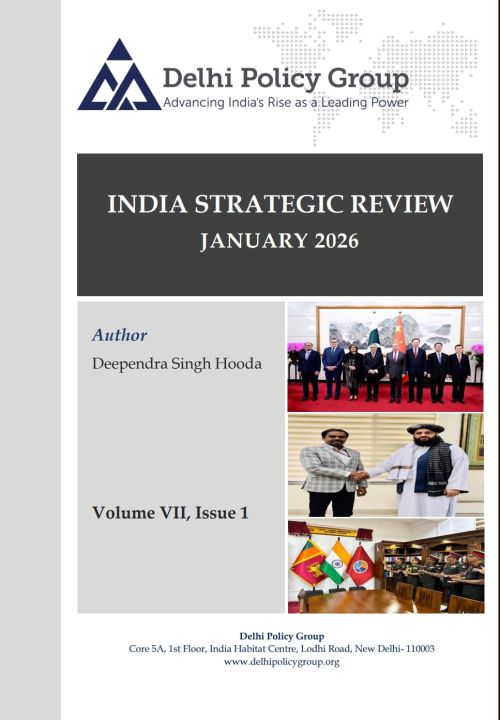
The ISR features an assessment of key developments, trends, and policies pertaining to India’s immediate and continental neighbourhood and is authored by Lt. Gen. Deependra Singh Hooda (Retd.), Distinguished Fellow for Military Strategy.
On January 4, Afghanistan enacted a new Criminal Procedure Code, which further restricts human rights and freedoms in the country. The code institutionalises a hierarchical society with religious scholars at the top, subject to the least punishment for a crime. It also entrenches discrimination against non-Hanafi Muslims and women, while clamping down on any dissent.
Pakistan–Afghanistan ties remain strained, with Pakistan calling the Afghan Taliban an armed group that had “occupied Afghanistan” and accusing the country of becoming a “hub for terrorists and non-state actors.” Pakistan is also attempting to exert economic pressure by keeping all border crossings closed since October 2025. However, Afghanistan’s trade has remained resilient in 2025, as exporters and importers have utilised alternative routes through Iran and Central Asia.
Taliban-appointed senior diplomat, Noor Ahmad Noor, took charge of the Afghan mission in New Delhi as chargé d’affaires on January 15. After Kabul halted the import of all medicines from Pakistan, India has stepped up with emergency healthcare supplies.
On January 4, Chinese and Pakistani foreign ministers met in Beijing. Both sides agreed to build an upgraded version 2.0 of the China-Pakistan Economic Corridor and pressed for “visible and verifiable” action against terrorist groups based in Afghanistan. The safety of Chinese personnel and projects in Pakistan also featured in the discussion.
Media reports indicate that Pakistan and Saudi Arabia are in talks to convert about $2 billion of Saudi loans into a JF-17 fighter jet deal. Bangladesh is also reportedly considering the procurement of the JF-17 after the visit of Bangladesh Air Force Chief, Hasan Mahmood Khan, to Pakistan in the first week of January.
Annual reports by Pakistani think tanks show a sharp deterioration in the internal security situation in 2025. Pakistan Institute for Conflict and Security Studies characterises 2025 as one of the most violent years since the post–Zarb-e-Azb decline, reporting 1,548 violent incidents (up 29% from 2024) and 3,413 fatalities (up 75%). Pak Institute for Peace Studies notes that 65% of the total recorded terrorist attacks in 2025 targeted security force personnel.
There was a diplomatic flare-up between New Delhi and Beijing over China's rapid infrastructure expansion in the Shaksgam Valley, which Pakistan ceded to China under a 1963 boundary agreement. The Shaksgam Valley lies in the Karakoram range, strategically located near the Siachen Glacier and the Line of Actual Control between India and China. While India has called the 1963 agreement invalid and illegal, China asserts that Shaksgam belongs to it and that any infrastructure construction is fully justified.
The February 12 election in Bangladesh is increasingly looking like a bipolar contest between the Bangladesh Nationalist Party (BNP) and the Jamaat-e-Islami-led alliance. Pre-poll assessments show a tight contest, with BNP holding a slight edge.
India-Bangladesh ties remain strained, with Bangladesh suspending visa services from its missions in Delhi, Kolkata, and Agartala. India has decided to withdraw the families and dependents of Indian officials posted in Bangladesh amid mounting security concerns. A Sheikh Hasina speech at an event in New Delhi, where she attacked Muhammad Yunus, the head of Bangladesh’s interim government, drew a sharp response from Dhaka on India permitting the event. Bilateral tensions also spilt over onto the sports field, with Bangladesh's exclusion from the T20 World Cup due to their refusal to travel to India.
Ahead of the March elections in Nepal, there is a churn in the political scenario. On January 14, the Nepali Congress formally split, with Gagan Thapa replacing Sher Bahadur Deuba as the leader. Increasing frustration is evident among Gen Z activists, who say the interim government has failed to address issues of nepotism and corrupt politicians. There is also a small but visible group demanding the restoration of the monarchy.
To read this issue please cllick India Strategic Review, Vol. VII, Issue 1.