


India’s Proximity Archives
South Asia
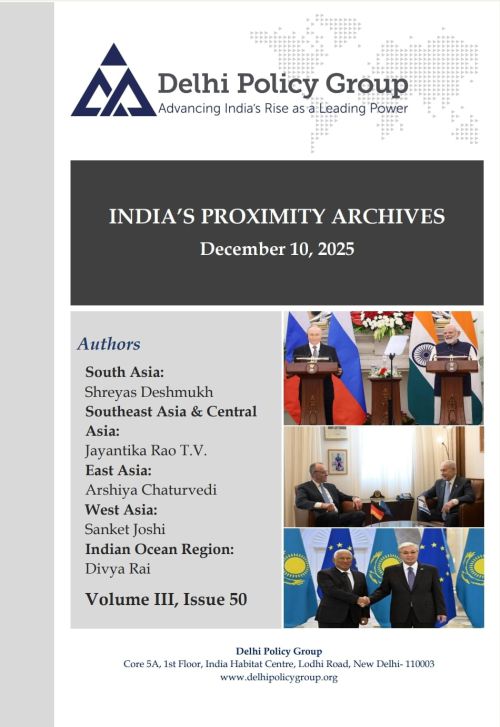
Russian President Vladimir Putin paid a state visit to India on December 4-5. Prime Minister Modi and President Putin convened the 23rd India-Russia Annual Summit to deliberate on bilateral matters and issues concerning regional and global developments. Sixteen Memoranda of Understanding were signed by the two countries, covering mobility and migration, health and food safety, maritime cooperation and polar waters, trade, and academic collaboration. The joint statement addresses collaboration in energy, connectivity, Arctic cooperation, civil nuclear endeavours, space exploration, counter-terrorism efforts, and engagement within UN and other multilateral platforms. In the press statement alongside President Putin, Prime Minister Modi prioritized the enhancement of connectivity between the two countries, adding that both parties are actively working towards an early conclusion of the Free Trade Agreement with the Eurasian Economic Union.
Southeast Asia
The Kuala Lumpur Peace Accord reached between Thailand and Cambodia was shattered after military clashes erupted along the neighbours’ disputed border on December 7. On December 8, it was reported that Thai F-16 fighter jets bombed Cambodian targets – including a casino near the border that Thailand accuses Cambodia of using it as a base for drones. Officials in Thailand and Cambodia each accused the other side of firing first, just as they had in July. As the third day of fighting continues, at least eight people have been killed, with the fighting spreading to more points along the disputed border, with accusations of rocket strikes and drone attacks in some areas. Thailand’s Prime Minister Anutin Charnvirakul told reporters that talks were futile because of Cambodia’s actions and that “Cambodia must comply to our conditions in order to stop the fight.” General Chaipruak Doungprapat, the Thai Army chief of staff, said his goal was to “render Cambodia incapable of military action for a long time.”
East Asia
China, on December 8, issued an official response to the US National Security Strategy released on December 4, declaring America’s security priority on Taiwan. The US Strategy document spells out the US’s objective to deter conflict over Taiwan through enhanced military buildup and consolidated military superiority in coordination with its allies. A Chinese Foreign Ministry spokesperson in a press conference remarked that Taiwan is the first red line in China-U.S. relations, and the US should exercise caution in supporting ‘Taiwan independence’ separatist forces. He further noted that China is willing to work with the US to promote stability in the region, but will not tolerate any external interference in its sovereign affairs, including Taiwan’s independence. The Taiwanese side has greatly appreciated this recently announced US stance on Taiwan and reaffirmed its strong commitment to strengthening its self-defence capabilities.
West Asia
On December 7, Israeli Prime Minister Benjamin Netanyahu met German Chancellor Friedrich Merz in Jerusalem, where both leaders reaffirmed their special partnership. PM Netanyahu informed that the first phase of the Gaza ceasefire was nearly complete and that he expects Israel to move on to phase two of the peace plan, which focuses on demilitarising Gaza and operationalising the UN-mandated International Stability Force. A "historic shift" in Israel-Germany relations was marked by Israel's handing over of the joint US-Israel developed "Arrow-3" ballistic missile defence system to the German Army.
Central Asia
On December 4, Kazakh President Kassym-Jomart Tokayev and European Council President António Costa issued a joint statement following constructive talks on advancing Kazakhstan–EU cooperation ahead of the 10th anniversary of the Enhanced Partnership and Cooperation Agreement. Tokayev emphasised that economic collaboration was central to the discussions, highlighting commitments to diversify trade and investment, foster a stable climate for European businesses, and pursue joint initiatives in energy efficiency, critical minerals, digital technologies, and transport connectivity—particularly through the Trans-Caspian International Transport Route. He outlined Kazakhstan’s ambition to integrate more deeply into European supply chains by promoting local processing, value-added production, and recycling. Costa, for his part, stressed that the European Union and Kazakhstan share a common vision rooted in multilateralism and a rules-based international order anchored in the UN Charter. He affirmed that these principles underpin joint efforts to advance global security, stability, and prosperity.
Indian Ocean Region
Australia’s Deputy Prime Minister and Minister for Defence, Richard Marles, and Minister for Foreign Affairs, Penny Wong, travelled to Washington DC for AUSMIN on December 8, 2025. They met US Secretary of State Marco Rubio and US Secretary of War Pete Hegseth to mark the 40th anniversary of these consultations, highlighting the alliance’s role in Indo-Pacific security. During the joint press conference, US Secretary of State Marco Rubio praised the US-Australia alliance as exceptionally strong, noting Australia's participation in every US war over recent decades and committing to further build the partnership. US Secretary of War Pete Hegseth highlighted enhancements to US force posture in Australia, including infrastructure upgrades at airbases in Queensland and the Northern Territory for bomber rotations, and in Darwin for Marine deployments and MV-22 Osprey prepositioning to create resilient logistics networks. Hegseth also emphasised deepening ties on the defence industrial base, covering guided weapons production, explosive ordnance, precision strike missiles, hypersonic cruise missiles, air-to-air missiles, and Mark 54 torpedoes, with goals for co-production and co-sustainment. The discussion also focused on the Australia, U.K. and U.S. trilateral security agreement known as AUKUS, which has been in place for just over three years.