


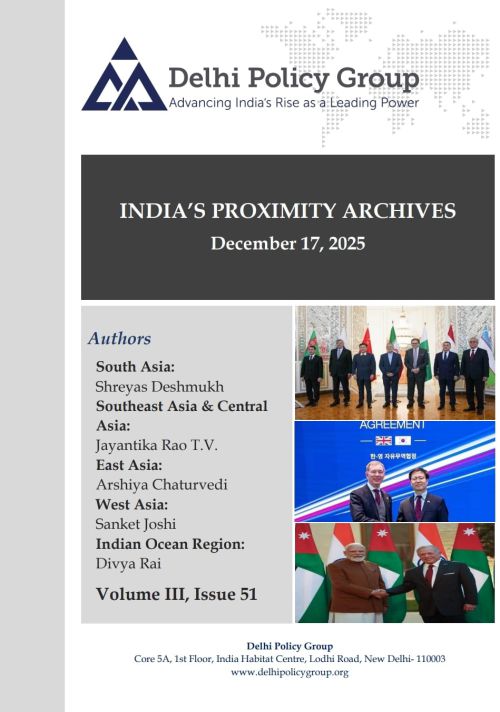
India’s Proximity Archives
South Asia
Bangladesh’s Chief Election Commissioner, AMM Nasir Uddin, announced that national elections rescheduled for February 12, 2026. Elections will be conducted in all 300 parliamentary constituencies, concurrent with a national referendum on the ‘July National Charter’. The Election Commission has established 42,761 polling centers and 244,739 booths to facilitate voting by an estimated 127.6 million voters. Concurrently, Bangladesh is still experiencing political violence. On December 12, an unidentified assailant in Dhaka shot a youth leader affiliated with a right-wing cultural organisation and a prospective candidate in the forthcoming general elections. Bangladesh’s Foreign Office summoned India’s envoy in Dhaka to convey its concern over allowing former Prime Minister Sheikh Hasina and her supporters to undermine the forthcoming general elections. India denied unequivocally, declaring that “New Delhi has consistently supported free, fair, and inclusive elections in the neighbouring country and has never allowed its territory to be used for activities hostile to the interests of the Bangladeshi people.”
Southeast Asia
As the border conflict between Thailand and Cambodia extended into its second week, heavy fighting continues. Efforts at mediation have failed to bring about a renewed ceasefire. On December 14, the Thai government reported that 16 soldiers had been killed since clashes began on December 7, alongside the displacement of 258,626 civilians. Thailand also confirmed its first civilian death directly linked to the fighting. Cambodia’s Ministry of Interior reported 11 civilians deaths, 74 injured, and the evacuation of nearly 400,000 people from border areas. Thai Prime Minister Anutin Charnvirakul dismissed claims that a ceasefire was in place, declaring that Thailand is determined to “preserve, protect, and defend the integrity of our land and our people at all costs.” Rejecting mediation attempts, Thailand announced a military operation to “reclaim Thai sovereign territory” in the coastal province of Trat and imposed a curfew across five districts on December 14, excluding the tourist islands of Koh Chang and Koh Kood.
East Asia
On December 15, South Korea and the UK signed a new trade deal replacing the 2019 post-Brexit continuity arrangement, parts of which were set to expire in January 2026. The two countries have agreed to maintain 98 percent of trade tariff-free. Currently, the total trade between the two countries is around £15 billion a year. The new agreement covers a wide array of export categories, including services, automotive, pharmaceutical and food and drinks, amongst others. In the automobile sector, the threshold on the quantity of parts in a car that must be British or from the EU to qualify for zero tariffs has been lowered from 55 percent to 25 percent.
West Asia
India’s Prime Minister Narendra Modi visited Jordan on December 15-16, marking the 75th anniversary of the establishment of India-Jordan diplomatic relations. PM Modi, during his meetings with Jordan’s King Abdullah II and Crown Prince Al-Hussein bin Abdullah II, pledged to deepen bilateral relations in domains such as trade and economic cooperation, agriculture, IT, healthcare, infrastructure, critical and strategic minerals, civil nuclear cooperation, and people-to-people ties.
Central Asia
On December 12, Turkmenistan hosted a high level international forum on “Peace and Trust” to mark the 30th anniversary of its neutrality. The event brought together global leaders including Russian President Vladimir Putin, Turkish President Recep Tayyip Erdoğan, Iranian President Masoud Pezeshkian, and the heads of Central Asian states. Discussions centered on peace, trust, dialogue, mutual respect, and multilateral cooperation, with participants noting that neutrality is becoming increasingly relevant in today’s international environment. The forum concluded with the adoption of the Ashgabat Declaration, which reaffirmed peace, trust, and dialogue as core principles and proposed initiatives such as a “Global Code of Trust” and a mediation chamber to strengthen international cooperation. President Putin welcomed the declaration emphasising the importance of peacefulness, non-interference, and respect for nations’ rights to choose their own development paths, traditions, and religions, principles he said are vital for stable international relations.
Indian Ocean Region
The Indian Navy commissioned DSC A20, the first of five indigenously built Diving Support Craft, on December 16 at Naval Base Kochi. DSC A20 has been designed and constructed as per the classification rules of the Indian Register of Shipping (IRS). It is a catamaran-hull ship, with a displacement of approx. 390 Tons. Fitted with state-of-the-art diving equipment, the vessel will play a vital role in underwater repairs and inspections, harbour clearances and critical diving missions in coastal waters.