


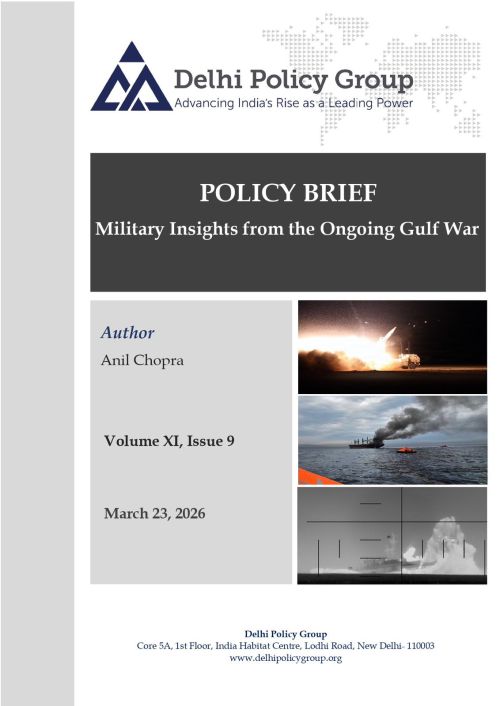
Military Insights from the Ongoing Gulf War
The massive air campaign launched by the US and Israel against Iran on February 28, 2026,has now engulfed the entire Gulf region. This has become a major armed conflict involving the deployment of the latest weapons, advanced platforms, and cutting-edge military technology, along with innovative and asymmetric tactics. The lessons from this intense and hyper-speed war are bound to impact the manner in which contemporary conventional wars will be prepared for and fought over the next decade or more.
This war is a clash of the two most technologically advanced militaries on one side, and a resilient Iran on the other, with the latter basing its strategy on low-tech low-cost mass weapons, including drones and missiles. The outcomes of the conflict in its totality, and those of daily multi-domain skirmishes, are likely to alter many military assumptions and tactics in regard to sudden conventional confrontations.
The author points out that even though it is premature to glean any definitive lessons from this war, one can already draw several inferences and insights, which also reaffirm the trends that have been observed in all recent wars.
Amongst the major takeaways from the last three weeks has been the relative success of Iran’s asymmetric response, using mass produced drones, fast interceptor craft and short-range missiles. The war has also generated many maritime controversies in regard to international law, naval warfare, and the effectiveness of surface warships in shallow and narrow waters like the Strait of Hormuz, mainly due to a lack of familiarity about the unique characteristics of the maritime domain, with its absence of sovereignty.
After addressing and analysing each of these aspects, the author highlights the unquestionable indispensability of joint and multi-domain operations, the limits of air power, the increasing impact of AI on the battle space, and the mushrooming trend of cognitive warfare. He further underscores that the Gulf conflict has reaffirmed the perennial nature of war itself, inclusive of the targeting of the apex leadership, the inevitability of collateral damage to civilians and civil infrastructure, and losses from friendly fire.
In conclusion, the author contends that modern conventional wars are likely to begin at very short notice and be very intense in the opening days and weeks, requiring nations in difficult neighbourhoods to focus much greater energy on deterrence and military preparedness at all times, with adequate stockpiling of ammunition and other consumable materiel. Death and destruction will no longer be confined to territorial borders and frontlines, as the hinterland can be struck by a variety of platforms at sea and in the air. Not least, the successful prosecution of war and effective defence will both require a coherent politico-military interface and a ‘whole of nation’ approach. For India, there is no alternative to speeding up the necessary reforms in its military and the development of defence capabilities commensurate with the myriad challenges to national security.
To read this DPG Policy Brief Vol. XI, Issue 9, please click “Military Insights from the Ongoing Gulf War”.